Solar solution for home and business
Why Renewable Energy Systems?
Many homeowners are installing solar systems to reduce their reliance on Eskom, lower their electricity bills, and make their homes more environmentally friendly.
Most electricity in a home is used in the early mornings and evenings and not during the day when solar power production is at it’s peak.
For this reason we recommend using hybrid systems with lithium battery storage to store solar power generated during the day and make use of all this stored energy to power your household lighting and appliances at night or during load shedding.
Our Services include:
Solar Panel Installation:
This includes assessing the site, designing the system, procuring the necessary equipment, and completing the installation process.
Solar System Design:
Customized solar system designs based on clients’ energy needs and available space.
Solar System Maintenance:
Regular maintenance services to ensure the optimal performance and longevity of solar energy systems. This may involve cleaning solar panels, inspecting electrical connections, checking system performance, and addressing any issues or malfunctions.
Solar System Repairs:
This could involve replacing faulty equipment, fixing electrical connections, or troubleshooting other issues affecting the system’s functionality.
Solar Financing and Consultation:
We can assist clients with understanding the various financing options available for solar installations, such as leasing, power purchase agreements (PPAs), loans, or government incentives. We help you make a informed decisions regarding your solar investments.
Energy Audits and Efficiency Improvements:
Conducting energy audits can help clients identify areas for energy efficiency improvements. By analyzing energy usage patterns, you can offer recommendations to optimize energy consumption and suggest additional measures to reduce energy waste.
Solar System Monitoring and Management:
We can provide monitoring systems that track the performance and energy generation of solar installations. These systems offer real-time data, enabling clients to monitor their energy production and consumption, identify potential issues, and optimize their energy usage.

Why go Solar for your business
Solar energy systems for businesses offer numerous benefits, including cost savings, environmental sustainability, and a positive brand image. Here are some key points regarding solar for businesses:
Cost Savings: Installing a solar energy system can significantly reduce electricity costs for businesses. By generating renewable energy on-site, businesses can offset their reliance on grid power and reduce their monthly utility bills. In some cases, businesses can even generate excess electricity and sell it back to the grid, further offsetting costs.
Return on Investment (ROI): Solar installations can provide a favorable return on investment over time. The payback period varies depending on factors like system size, energy consumption, available incentives, and electricity rates. Generally, businesses can expect to recoup their investment within a few years and enjoy long-term savings for the lifespan of the system.
Tax Incentives and Rebates: Many governments and local authorities offer tax incentives, grants, or rebates to encourage businesses to adopt solar energy. These incentives can help offset the upfront costs of installation and improve the financial feasibility of solar projects.
Energy Independence and Stability: By generating their own electricity, businesses become less reliant on traditional energy sources and are better insulated from fluctuating utility rates. This provides stability and reduces the vulnerability to energy price increases in future.
Environmental Sustainability and Corporate Social Responsibility (CSR): Adopting solar energy demonstrates a commitment to sustainability and reducing carbon emissions. This aligns with corporate social responsibility goals and can enhance a business’s brand image, attracting environmentally conscious customers and stakeholders.
Energy Resilience and Backup Power: Solar energy systems can be combined with energy storage solutions, such as batteries, to provide backup power during grid outages. This ensures business continuity, particularly for critical operations that require a constant power supply.
Green Certifications and Recognition: Solar installations can contribute to earning green certifications, such as LEED (Leadership in Energy and Environmental Design), which recognizes environmentally friendly buildings. Such certifications can enhance a business’s reputation and provide a competitive advantage.
Scalability and Flexibility: Solar systems can be designed to meet the specific energy needs of businesses of all sizes. Whether it’s a small office building or a large industrial facility, solar installations can be scaled accordingly. Additionally, solar energy systems can be integrated with existing electrical infrastructure and easily expanded or modified as business needs evolve.
Before proceeding with a solar installation for a business, it’s advisable to conduct a feasibility study, which assesses energy consumption, available roof or land space, financial considerations, and any regulatory requirements. Working with a reputable solar service provider or consultant can help guide businesses through the entire process, from initial assessment to system design, installation, and ongoing maintenance.
How Does It Work
Solar panels collect energy from the sun and convert it into DC electricity, which is sent to the inverter. The inverter is one of the most important components of the system and has two very important functions. It takes the electricity from the solar panels and charges the batteries as well as converts the DC from the batteries and solar panels into 230V AC.
The AC electricity is then fed into your home to power your lighting and household appliances.
There is no need to change any of your lighting or appliances.
Any excess solar power that is not used during the day is used to charge your battery storage system. The battery storage system supplies power to your inverter at night, when there is insufficient solar power available to satisfy your power needs, or during load shedding.
Many homes & businesses are adopting solar energy solutions to reduce their environmental impact, lower energy costs, and improve their sustainability profile.
010 006 6500 | 084 991 1326
Types of Solutions
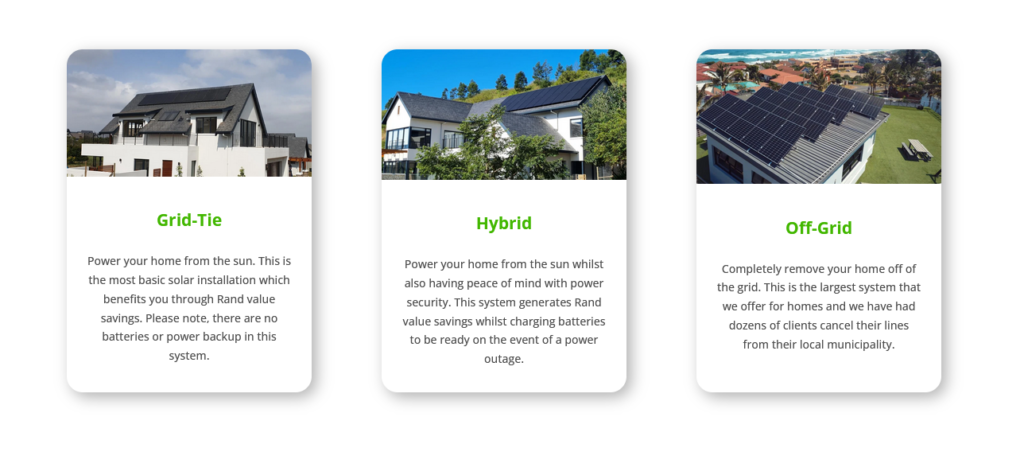
A grid-tied system is connected to and dependent on the utility grid.
These systems are developed to lower and supplement the power utility’s ability to lower your electricity bills.
These systems generate electricity from the sun, but rather than storing excess power in batteries for backup, they export it to the utility grid.
If the home or business requires more power than what is available from the solar panels, the power is then pulled from the utility grid.
A hybrid solar system is a solar power system that uses solar panels, a hybrid inverter and a battery bank.
The solar panels convert sunlight into electricity, while the batteries store the power for use when there is little sun or at night.
Hybrid solar systems have both on-grid and off-grid capabilities, allowing you to continue running on solar power even if there is load shedding.
An Off Grid solar system is very much like the hybrid solar system, however there is no utility grid connection.
All the excess power generated during the day for the solar panels needs to be stored in a sizeable battery bank to enable the house/property to last through the night.